How to Create a Family Emergency Binder: The Step-by-Step Guide Every Family Needs
To create a family emergency binder, gather your medical records, legal documents, financial account information, insurance policies, digital access instructions, and emergency contacts into one clearly labeled, centralized system — either physical or digital — and store it somewhere trusted family members can find it fast.
That’s the short answer. But if you’ve ever watched someone frantically search for an insurance card in the middle of a medical crisis, or tried to locate a will while grieving — you already know the real cost of not having one. This guide walks you through every section, every common mistake, and the real-world logic behind why this simple binder can be one of the most powerful things you do for your family this year.
What Is a Family Emergency Binder (And Why It’s Not What You Think)?
Most people hear “emergency binder” and imagine tornado kits or survival guides. That’s not what this is.
A family emergency binder is a centralized, organized system that holds every document and piece of critical information your family might need during a high-stress moment — a hospitalization, a sudden death, a house fire, or even something as logistically chaotic as a cross-country relocation.
Think of it as the instruction manual for your family’s life. Not morbid. Not dramatic. Just prepared.
The average household has critical documents scattered across filing cabinets, kitchen drawers, email inboxes, safe deposit boxes, and that “I’ll deal with it later” pile on the counter. When something goes wrong, that scattering becomes a real problem — not just emotionally, but practically. People make worse decisions under stress. They forget things. They argue. They delay.
A family binder removes those obstacles.
Why Every Family Needs One — Including Yours
Here’s a scenario that plays out more often than most families expect:
A husband in his mid-50s has a stroke. He’s stable, but unconscious. His wife of 28 years suddenly needs to know: Which hospital does their insurance cover? Who is his primary care doctor? Is there a healthcare directive? Does he have a power of attorney in place — and if so, where is it?
She has no idea. Not because she’s uninformed. Because no one ever sat down and created a system.
This is not a story about worst-case scenarios. It’s about the very predictable moments life throws at ordinary families. Job loss, medical events, natural disasters, identity theft, sudden travel, a parent’s unexpected death — any one of these creates a need for fast, clear access to information.
The family emergency binder is how you give that to your people and How to Create a Family Emergency Binder .
Step 1: Choose Your Binder Format
Before you worry about what goes inside, decide how you want to structure it.
Option A: Physical 3-Ring Binder This is the most accessible option. Use a 1.5- to 2-inch binder with tabbed dividers. Keep it somewhere known — a home office shelf, a fireproof safe, or a dedicated drawer. The advantage here is zero technology required, even during a power outage.
Option B: Digital Folder System Google Drive, iCloud, or a dedicated service like Dropbox can work well for tech-comfortable families. The risk is access — if the person who knows the passwords is the one in the hospital, a purely digital system can lock everyone out.
Option C: Hybrid Approach This is what most preparedness professionals recommend. A physical binder holds the originals and printed copies. A digital backup lives in a shared cloud folder that a trusted family member can access.
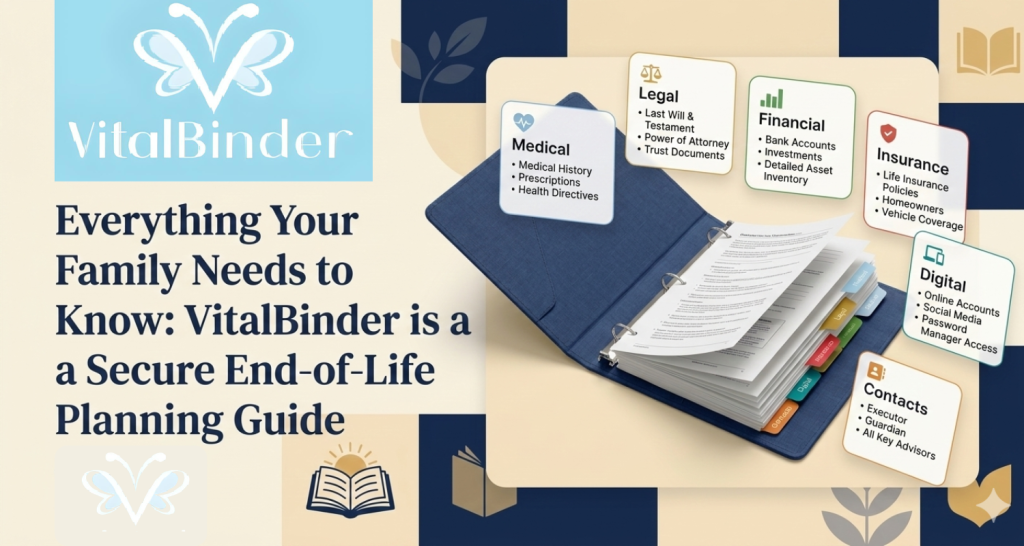
Option D: Structured Systems Like VitalBinder For families who don’t want to build this from scratch, systems like VitalBinder offer pre-labeled sections, fillable formats, executor guidance, and even pet care documentation — removing the guesswork entirely.
Whatever format you choose, the non-negotiable is this: it must be findable by more than one person in your household.
Step 2: Organize Medical Information
This section tends to be the most immediately useful — and the most neglected.
Include the following: How to Create a Family Emergency Binder
- Current medications list — drug name, dosage, prescribing physician, and what condition it treats
- Known allergies — including reactions and severity
- Chronic or significant medical conditions — with diagnosis dates when possible
- Primary care physician contact — name, phone, practice address
- Specialist contacts — cardiologist, oncologist, therapist, whoever is relevant
- Health insurance information — carrier, policy number, group number, member ID
- Physical copies of insurance cards — front and back
One detail people frequently miss: include a brief note on preferred hospitals or known medical preferences. If your father has a standing relationship with a specific cardiac team, that context matters to emergency responders.
Step 3: Include Legal Documents
Legal documents don’t need to live in the binder — originals should typically be stored with an attorney, in a fireproof safe, or in a secure deposit box. But your family binder should contain: How to Create a Family Emergency Binder
- Last Will and Testament (reference copy and location of original)
- Trust documents, if applicable
- Durable Power of Attorney — who can make financial decisions on your behalf
- Healthcare Power of Attorney — who can make medical decisions if you cannot
- Advance Directive / Living Will — your documented medical wishes
- Guardianship designations — especially critical for families with young children
If your state has specific witnessing or notarization requirements for these documents, note whether those have been satisfied. An unexecuted directive is not legally binding, no matter how sincerely intended.
The American Bar Association’s Consumer Guide to Powers of Attorney is a solid starting point for understanding what each document does and when it applies.
Step 4: Gather Financial Information
You don’t need to store account passwords here. In fact, you shouldn’t. What you do need is enough information that a trusted person can locate, contact, and work with your financial institutions if necessary. How to Create a Family Emergency Binder ,
Include:
- Bank accounts — institution name, account type, approximate branch location
- Retirement accounts — 401(k) or IRA provider, account reference
- Investment accounts — brokerage name and advisor contact, if applicable
- Mortgage information — lender, loan number, monthly payment amount, escrow details
- Credit card accounts — issuers and contact numbers (not full card numbers)
- Pension or annuity details — provider, plan type, beneficiary designations
For password and account access instructions, create a separate sealed envelope or use a password manager. Note which password manager and provide instructions for how to access it — not the master password itself, but the method.
Step 5: Add Insurance Documentation
Insurance paperwork is notoriously hard to locate under pressure. Gather the following and note whether each policy is active:
- Life insurance — carrier, policy number, death benefit amount, beneficiary name, agent contact
- Health insurance — see Step 2
- Homeowners or renters insurance — carrier, policy number, coverage limits, agent contact
- Auto insurance — carrier, policy number, vehicles covered
- Long-term care insurance — if applicable, carrier and benefit triggers
Note the renewal dates. Note the agent’s direct line. These details save hours of phone navigation during the exact moments no one has hours to spare.
Step 6: Document Digital Assets
This section is the most frequently skipped — and increasingly the most consequential.
Your digital footprint includes far more than most people realize:
- Email accounts — provider, username (not password — see Step 4 instructions)
- Online banking platforms — which institutions have digital-only accounts
- Social media accounts — Facebook, Instagram, LinkedIn, and how you’d want them handled
- Cloud storage accounts — Google Drive, iCloud, Dropbox, and what’s stored there
- Password manager instructions — app name, how to access the vault, emergency contact method
Some platforms, like Facebook, allow you to designate a Legacy Contact — someone who can manage your account after death. Google offers a similar feature through Inactive Account Manager. These take ten minutes to set up and can prevent a lot of confusion later.
Step 7: Emergency Contacts
This section should read like a fast-dial list. Provide:
- Executor of estate — name, phone, relationship
- Attorney — name, firm, direct line
- Financial advisor — name, firm, phone
- Insurance agent(s) — name, agency, phone
- Employer HR contact — for workplace benefits, life insurance through employer, or payroll continuation
- Trusted family contacts — the people who should be called first, and in what order
Add one line per person. Don’t bury the list in paragraphs. In a moment of crisis, no one is reading carefully — they’re scanning.
Property, Assets, and the Things People Forget
A well-organized family binder goes beyond the obvious. Consider also including: How to Create a Family Emergency Binder ,
- Real estate documents — deeds, property tax account numbers, HOA contacts
- Vehicle titles — especially if stored somewhere other than the glove compartment
- Safe deposit box information — institution, box number, key location
- Business ownership documents — for self-employed individuals or small business owners
- Valuables inventory — a written or photo-documented list of significant items for insurance purposes
That last one is consistently overlooked. If your home is damaged, a written inventory with photos makes insurance claims vastly smoother. FEMA’s ready.gov recommends keeping a home inventory as part of basic disaster preparedness and How to Create a Family Emergency Binder .
Common Mistakes People Make When Building a Family Binder
Waiting for the “right time.” There is no right time. The binder doesn’t need to be perfect to be useful. Start with what you have and add to it over time.
Not telling anyone where it is. A binder that no one can find is just organized clutter. Tell your spouse, your adult children, your executor — whoever would need it — exactly where it lives.
Storing only originals. Original documents get damaged, lost, or tied up in a safe deposit box that requires a court order to open after death. Work from copies. Store originals securely. Reference where they are.
Ignoring digital assets. As of 2024, the average American has dozens of online accounts. Many hold real financial or sentimental value. Ignoring them creates a genuine access problem for surviving family members.
Never revisiting it. A binder built in 2019 reflects a 2019 life. Update it annually at minimum — and after any major life event.
How Often Should You Update Your Family Emergency Binder?
Review your family binder once a year, and after any of the following: How to Create a Family Emergency Binder .
- Marriage, divorce, or domestic partnership changes
- Birth or adoption of a child
- Death of a named contact or beneficiary
- Major asset purchase or sale (home, vehicle, business)
- Significant health diagnosis or surgery
- Relocation to a new state or country
- Retirement or change in employment
- Changes to estate planning documents
A useful habit: tie your annual review to a recurring event — tax season works well for many families because financial documents are already out and accessible.
FAQs About Creating a Family Emergency Binder
What should I put in a family emergency binder?
A family emergency binder should include medical information (medications, conditions, insurance), legal documents (will, power of attorney, healthcare directive), financial account details, insurance policies, digital asset instructions, and a clear list of emergency contacts. The goal is to give any trusted person enough information to act on your behalf.
Should I keep my family binder digital or physical?
Both approaches have trade-offs. Physical binders are always accessible, even without power or internet. Digital binders are easier to update and share remotely. Most preparedness experts recommend a hybrid system — a physical binder with a digital backup stored in a shared cloud folder or password-protected drive.
Is a family emergency binder the same as a go-bag?
No. A go-bag is a physical kit with supplies for immediate evacuation — food, water, clothing, flashlights. A family emergency binder is an information system, not a supply kit. They complement each other but serve different purposes.
Do I need an attorney to create a family emergency binder?
Not for the binder itself — you can organize and assemble it on your own. However, the legal documents that belong in the binder (will, power of attorney, advance directive) typically require an attorney to draft and properly execute. A notarized document is legally binding in a way a handwritten note is not.
How do I safely store my family emergency binder?
Store your physical binder in a fireproof, waterproof container at home, and inform trusted family members of its location. Keep a digital backup in a secure, shared cloud folder. Never leave it somewhere only you can access — the whole point is that someone else can use it when you cannot. and How to Create a Family Emergency Binder .
When a DIY Approach Isn’t Enough
Building a family binder from scratch is entirely doable. But many families find that starting from a blank document leads to gaps — entire categories they didn’t think of, sections that aren’t intuitive, or a system that’s hard for someone else to navigate under pressure.
Structured systems like the VitalBinder at vitalbinder.co are designed to address exactly this. Pre-labeled sections, executor guidance, pet care documentation, funeral planning prompts, and fillable templates make the process faster and the result more complete. It’s not about buying a product — it’s about not reinventing a wheel that has already been carefully designed. and How to Create a Family Emergency Binder .
Final Thoughts: Preparedness Is an Act of Love
Creating a family emergency binder is not about expecting disaster. It is not a morbid exercise or an admission of fear. It is one of the clearest, most practical ways to tell your family: If something happens to me, I don’t want you to suffer more than necessary.
That’s the real reason to do this. Not because emergencies are inevitable — though some are — but because the people you love deserve clarity in their hardest moments. They deserve to spend their energy grieving, healing, or problem-solving rather than hunting for a policy number.
Start today. Start imperfect. A binder with six things in it is infinitely more useful than a binder you’re still planning to build. and How to Create a Family Emergency Binder .
About the Author
Laura Holeyfield is the Founder of VitalBinder. After personally navigating medical chaos during a family health crisis, Laura built VitalBinder from the ground up — driven by a firsthand understanding of how devastating preventable confusion can be during an emergency. Her work centers on preparedness, documentation systems, and helping families replace uncertainty with clarity. Laura knows this space not just professionally, but personally.
This article was reviewed for factual accuracy and updated in March 2026. and How to Create a Family Emergency Binder .