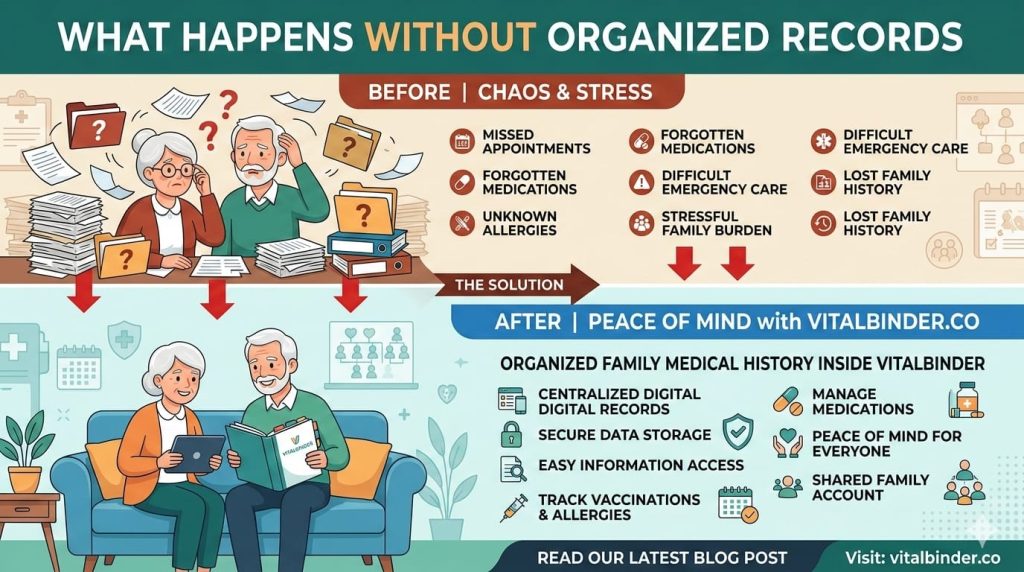
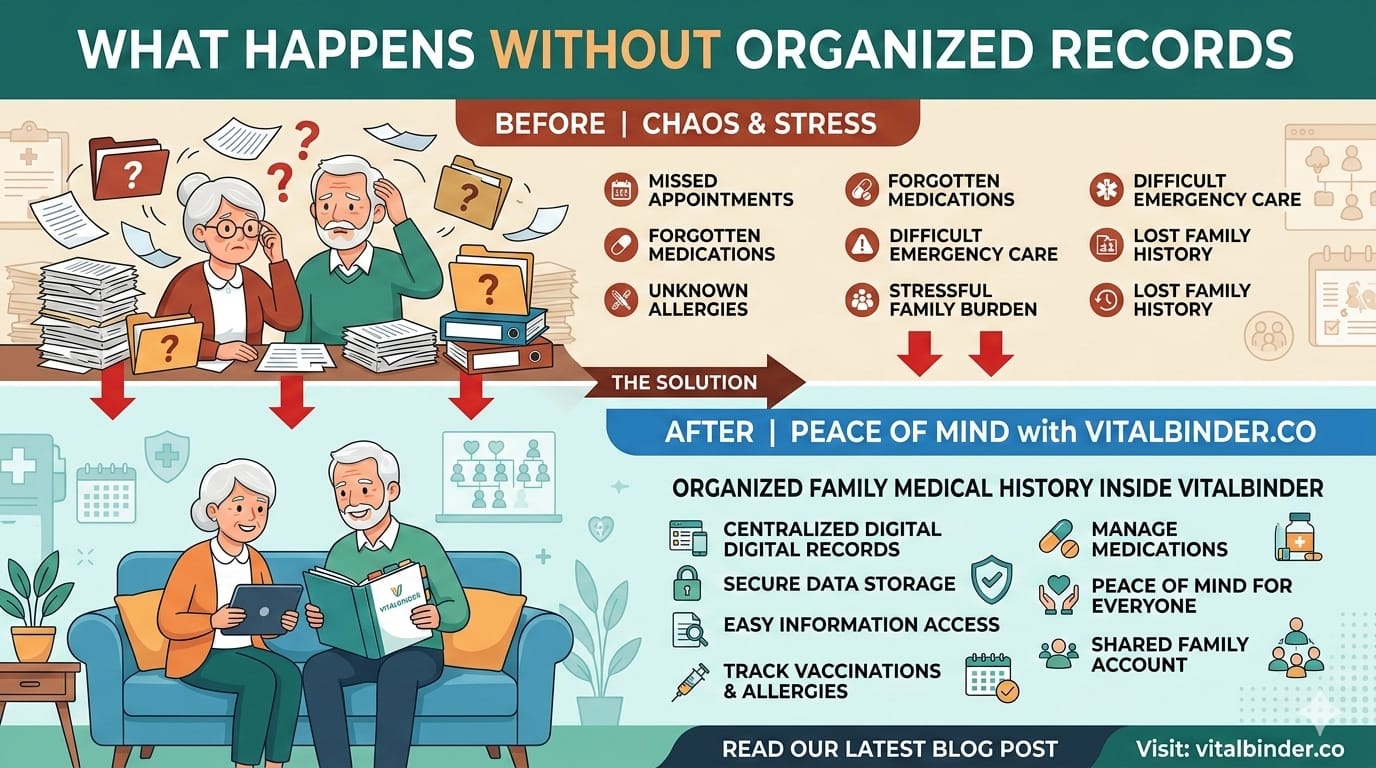
Your family medical history can determine treatment decisions, emergency care speed, and even survival outcomes. When that information isn’t accessible, stress multiplies and mistakes happen. VitalBinder exists because I experienced firsthand what happens when critical medical and personal information isn’t organized when you need it most.
And I never want another family to feel that unprepared.
When I Needed Information Fast — And Didn’t Have It
There’s a moment you don’t forget.
I took in a terminally ill family member I didn’t know very well. Things escalated quickly. Within days, I was on the phone with multiple doctors, scheduling appointments, answering intake questions.
And every call sounded the same:
- “What’s the past medical history?”
- “Any recent hospitalizations?”
- “Current medications?”
- “Previous surgeries?”
- “Family medical history?”
Silence.
I didn’t know.
I felt exposed. Unprepared. Almost negligent — even though I had just stepped in to help.
Every conversation meant scrambling. Digging through scattered papers. Searching drawers. Trying to piece together a puzzle that should have been complete.
That experience changed me.
Why Family Medical History Is More Important Than Most People Realize
According to the <a href=”https://www.cdc.gov/genomics/famhistory/famhist.htm” target=”_blank” rel=”noopener”>Centers for Disease Control and Prevention (CDC)</a>, family medical history helps healthcare providers identify risks for heart disease, cancer, diabetes, and hereditary conditions.
It’s not just paperwork.
It guides:
- Diagnostic testing
- Preventative screening schedules
- Medication decisions
- Surgical risk evaluation
Without accurate family medical history, doctors work with incomplete information. That delays care.
And in emergencies? Delays matter.
The Realization That Changed Everything
After things settled, a heavier realization hit me:
Life changes fast.
We think we’re organized. We think our spouse “knows everything.” We assume our adult children could figure it out.
But could they?
I started thinking about my own son. If something happened to me tomorrow, would he know:
- My doctors?
- My prescriptions?
- My insurance details?
- My bank accounts?
- My login credentials?
- My full family medical history?
Probably not.
And even if he eventually found everything, it would take days. Maybe weeks. During grief.
That’s not a gift. That’s a burden.
The Digital Illusion of Being Organized
We live in a digital age. Everything is “saved somewhere.”
Patient portals. Banking apps. Email confirmations. Cloud storage.
But here’s the problem:
- What if someone doesn’t know your passwords?
- What if two-factor authentication goes to your phone?
- What if no one knows your device login?
Security has improved — and rightly so. But it creates barriers in crisis situations.
The <a href=”https://www.consumerfinance.gov/” target=”_blank” rel=”noopener”>Consumer Financial Protection Bureau</a> warns families that accessing financial accounts after death can be time-consuming without documentation.
Digital alone isn’t enough.
Sometimes we need something tangible. Clear. Immediate.
What Happens When Someone Dies Without Organized Records?
Let’s talk honestly.
When someone passes away, families face:
- Bank accounts
- Credit cards
- Utilities
- Mortgages
- Tax records
- Insurance policies
- Medical debt
- Estate documents
Each institution requires:
- Account numbers
- Verification
- Security answers
- Death certificates
If no centralized record exists, the process becomes exhausting.
I’ve seen it.
It compounds grief.
So What Is VitalBinder — And How Does It Protect Your Family?
VitalBinder is a structured, physical system designed to centralize:
- Family medical history
- Current diagnoses
- Medication lists
- Doctor contacts
- Insurance details
- Emergency contacts
- Financial accounts (non-password details)
- Legal documents overview
It isn’t about replacing digital systems. It complements them.
It provides clarity when clarity matters most.
How Organizing Family Medical History Changes Emergency Outcomes
In emergency care, providers often ask:
- “Any allergies?”
- “History of stroke?”
- “Cardiac conditions in the family?”
- “Recent procedures?”
When answers are immediate, treatment accelerates.
Research published by the <a href=”https://www.nih.gov/” target=”_blank” rel=”noopener”>National Institutes of Health (NIH)</a> shows that accessible patient history reduces medical errors and improves clinical decision-making.
That’s not theoretical.
That’s real.
What Should Be Included in a Family Medical History Record?
Here’s what most people miss.
Your family medical history should include:
Immediate Family
- Parents’ diagnoses
- Siblings’ conditions
- Grandparents’ major illnesses
- Cause of death (if applicable)
Personal Medical Data
- Chronic conditions
- Surgeries (with dates)
- Medication history
- Allergies
- Hospital stays
Ongoing Care
- Specialists
- Primary care provider
- Pharmacy
- Insurance carrier
Most families don’t have this in one place.
That gap is exactly why VitalBinder exists.
The Emotional Side No One Talks About
Organization isn’t just logistical.
It’s an emotional relief.
When you lose someone — or fear losing them — your brain doesn’t function at full capacity. Decision fatigue is real. Grief affects cognitive processing.
Having a system already built removes hundreds of micro-decisions.
That’s a gift to your family.
Internal Resources
If you’re just starting, I recommend reading:
(These internal guides help you build a complete preparedness system.)
Frequently Asked Questions (FAQ)
1. Why is family medical history important in emergencies?
Family medical history helps doctors assess genetic risks and make faster treatment decisions. In emergencies, immediate access to conditions, allergies, and past surgeries reduces delays and medical errors.
2. How often should family medical history be updated?
Review it annually or after any major diagnosis, surgery, or medication change. An outdated record can be almost as harmful as having none.
3. Is digital storage enough for medical records?
Digital storage is helpful but not sufficient. Access barriers like passwords and two-factor authentication can delay critical information retrieval during emergencies.
4. What is the difference between a medical binder and estate planning documents?
A medical binder focuses on health and treatment history, while estate planning covers financial and legal matters. Both are essential for complete preparedness.
5. Who should have access to my family medical history?
Spouse, adult children, caregivers, and anyone legally designated to make healthcare decisions should know where it’s stored.
The Bigger Picture
VitalBinder wasn’t created as a product idea.
It was created from lived experience.
From frustration. From scrambling. From the quiet panic of not knowing answers when answers mattered.
If you’ve ever tried to locate documents during a stressful moment, you understand.
Preparation isn’t paranoia.
It’s protection.
Why Family Medical History Must Be Organized Before It’s Needed
Your family medical history is one of the most powerful tools you can give your loved ones. When organized clearly and accessibly, it reduces stress, speeds care, and prevents chaos during already difficult moments.
VitalBinder exists to bring order before an emergency happens.
Because life changes fast.
And clarity should never depend on luck.
If you’re ready to protect your family, explore our complete VitalBinder system and start organizing today.
Author
Laura Holeyfeld — Founder of VitalBinder
After personally navigating medical chaos during a family health crisis, Laura created VitalBinder to ensure families never face preventable confusion during emergencies. Her work focuses on preparedness, documentation systems, and reducing stress through organization.